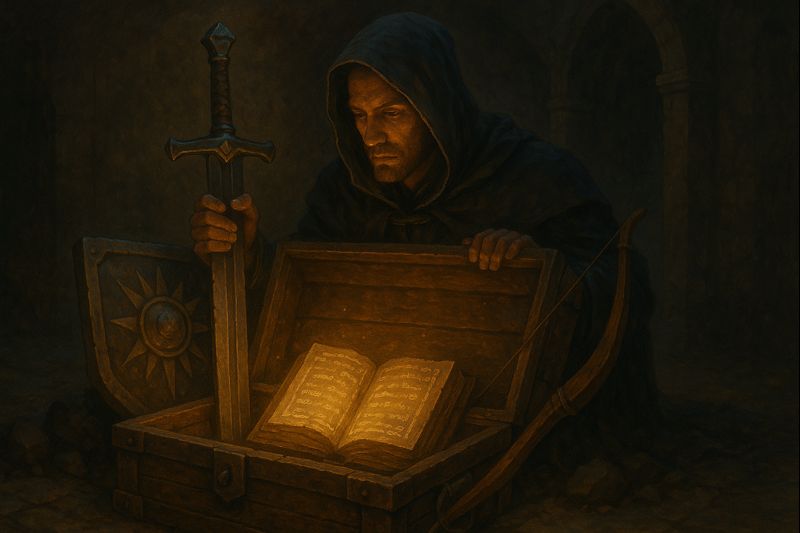
In every great RPG, there is a moment when the entire trajectory of the adventure shifts.
A chest opens. A boss falls. A mentor hands you a blade that is more than metal. A spellbook reveals a technique that rewrites your limits.
Legendary gear is never just gear. It is a defining moment that pushes the hero into a new tier of capability, confidence, and identity.
Careers work the same way.
Although the pace is slower and the quests are less dramatic, each of us experiences moments when everything changes. A rare skill cracks open opportunities. A mentor speaks a sentence that reshapes our path. An unexpected challenge forces us to grow. A team hands us real responsibility.
These become our legendary items. They shape our endgame.
And I will be honest. I did not always think in those terms.
For a long time, I treated career growth like a checklist. Learn the tools. Get the cert. Build the resume. Move up.
But in cybersecurity, especially as you move into leadership, you eventually learn a different truth.
It is not the checklist that separates people.
It is the gear they earned during the hard parts.
Not fantasy rewards. Real tools and moments that change your trajectory. Cybersecurity has no golden swords or mythical armor, but it does have rare capabilities, powerful frameworks, and careers forged by the people and experiences that gave us our first breakthrough.
Here is the question I keep coming back to as I build out this season of my writing.
What legendary gear has shaped your journey so far, and what legendary gear do you still need for the next season of your growth?
Consider this an invitation to step back, examine your own story, and recognize the tools that already earned a place in your vault.
Legendary Gear Item 1: Rare Skills That Others Do Not Have
In RPGs, legendary items grant abilities that standard weapons can never match. A bow that pierces armor. A staff that doubles spell power. A shield that reflects damage.
These items change the entire game because they expand the hero’s possibilities.
Rare skills do the same.
Every career reaches a point where basic competence is no longer enough. To unlock higher level quests, the professional has to develop something uncommon. Something that others rely on. Something that becomes leverage.
In cybersecurity, I have seen this play out many times. Someone learns a niche skill that others avoid, and suddenly they become the person everyone calls when the challenge is serious.
Examples include:
- incident response leadership under pressure
- transforming technical chaos into executive clarity
- automation that removes entire categories of pain
- threat modeling that reduces complexity with elegance
- understanding both the tactical and strategic landscape
- mastering tools that others treat as intimidating or optional
Rare skills are often earned during difficult seasons.
A breach that forced you to grow.
An outage that required fast learning.
A near miss that revealed your blind spots.
A project that demanded mastery of an unfamiliar domain. Those are forge fires. They upgrade your character sheet whether you wanted the upgrade or not.
Your rare skill becomes legendary gear because it continues to support you long after the moment that forced you to learn it. It becomes a permanent part of your loadout.
One of my own gear upgrades was learning to move between two worlds without losing credibility in either. Deep technical work on one side. Clear, executive-level narrative on the other.
I realized I could not hide behind technical excellence. I had to translate it.
Early in my career, I could explain what was wrong. I struggled to explain why it mattered.
The day that changed was the day I had to brief leaders who did not care about the tool or the terminology. They cared about impact, cost, and speed.
That became a permanent upgrade for me.
It is the difference between ‘I found a risk’ and ‘I changed an outcome.’
What is the rare skill you sharpened the hard way? Has it carried you further than you expected?
Legendary Gear Item 2: Mentors Who Hand You a Better Weapon
Legendary RPG moments often involve a mentor handing the hero something powerful. A battle tested blade. A spell that took decades to master. A custom crafted tool that fits only them.
In real life, mentors do the same thing. They give access to knowledge, feedback, perspective, or courage that you cannot acquire alone.
Mentorship is one of the most undervalued forms of legendary gear because it rarely looks dramatic. Most often it looks like:
- an honest conversation about your blind spots
- a small opportunity that becomes a major proving ground
- a recommendation they did not have to give
- a lesson learned from their own hard mistakes
- permission to think bigger about your future
- a challenge that pushed you out of your comfort zone
When a great mentor enters your story, your growth accelerates. You stop leveling slowly. You leap.
Looking back, some of the most important “upgrades” I received were not technical. They were mental models delivered at exactly the right time. I still remember a mentor stopping me mid-explanation and saying,
“You are trying to win the argument. That is not the job. The job is to help them make a decision.”
I remember exactly how quiet the room got after he said it.
That one line rewired how I show up. I stopped presenting security like a courtroom case and started presenting it like a tradeoff: here are the options, here is the risk, here is what I recommend, and here is what it buys us. That shift made me better overnight, not because I learned more, but because I finally learned how to be useful.
Mentors are legendary gear because the upgrade stays with you long after your paths diverge. You feel their influence every time you step into a difficult conversation, tackle a new initiative, or choose the harder but better path.
Who are the mentors who handed you legendary tools? Have you told them?
Legendary Gear Item 3: Game Changing Opportunities
Every RPG has a moment when the hero accepts a quest that feels too big. A mission above their level. A battle the world assumes they cannot win.
They take it anyway.
Sometimes they succeed. Sometimes they fail forward. Either way, their stats improve.
Opportunities are legendary gear because they become turning points between who you have been and who you are becoming.
There are three types of opportunities that qualify as legendary:
1. The first big opportunity that proves what you can do
This might be your first leadership moment, your first major project, your first breach response, or your first time owning an initiative end to end. It becomes a core memory you carry forward.
2. The unexpected opportunity that forces rapid growth
In cybersecurity, this often appears when something breaks or a client is in urgent need. Growth under pressure leaves scars, but it also leaves strength.
3. The chosen opportunity that reflects your long term calling
This is the moment you intentionally pursue the next level of your craft. A certification, a new role, a specialization, or a bold transition that others think is risky.
A lot of my growth came from accepting work that felt like a stretch, then building structure fast enough to survive it.
One opportunity changed my trajectory because it was the first time I truly owned the outcome.
No hiding behind a team. No ‘I just handle the technical side.’
I had to make the call, communicate it clearly, and live with it.
That did not just upgrade my skills. It upgraded my identity.
It taught me what responsibility actually feels like.
What opportunity changed your trajectory the most?
Legendary Gear Item 4: Tools, Systems, and Frameworks That Level Up Capability
In RPGs, legendary gear often provides passive bonuses. A ring that increases resilience. A cloak that improves stealth. A charm that boosts critical chance.
Careers have their own passive bonuses.
They emerge from tools, frameworks, habits, and systems that operate quietly in the background, making us better at what we do.
For cybersecurity professionals, these might include:
- automation scripts that eliminate repetitive tasks
- dashboards or frameworks that enhance visibility
- threat modeling templates that simplify complexity
- a personal knowledge system that accelerates learning
- refined workflows for incident response or vulnerability management
- AI assistants or RAG systems that speed up investigation and analysis
These tools are often unique to each professional. They are not universal industry artifacts. They are custom crafted legendary items that only you can wield effectively.
I eventually accepted something about myself: I cannot hold an entire complex situation in my head and pretend it is fine. I need an external map. That is why systems thinking became my default tool.
When a problem is messy, I write it down. I break it into phases. I define the next action. I build a way to measure progress. That is not just productivity, it is survival. Especially in cybersecurity, where the difference between “we are fine” and “we are not fine” is often a handful of overlooked details.
Your cognitive tools are legendary gear. The more you refine them, the more powerful your career becomes.
Legendary Gear Item 5: The Identity Shift After a Hard Won Victory
This final category is the most intangible, but it is also the most transformative.
There is a moment in every RPG when the hero realizes they are no longer the same person who began the quest. Their posture changes. Their confidence shifts. Their identity catches up to their capability.
In careers, this often happens after:
- navigating a high stress crisis
- leading a team through uncertainty
- owning the outcome of a tough decision
- surviving a setback that did not break you
- completing something that required long term discipline
The shift is internal, but the impact is external. You speak differently. You think differently. You show up differently. You stop viewing your career through the lens of self doubt. You begin to operate like the version of yourself that others already saw.
The identity shift for me did not come from praise. It came after the fact, usually in the quiet. After the stressful call. After the decision. Usually late, when the adrenaline wears off. After the moment where everyone wanted certainty and I had to move with incomplete information anyway. I would look back and realize, I did not freeze. I did not crumble. I made the best call I could with what we had, and I kept moving. That is where real confidence comes from. Not from feeling ready, but from surviving the moment and becoming the kind of person who can handle the next one.
Identity upgrades are the highest tier of legendary gear. Not a weapon. Not a tool. Not a mentor. Not a certification.
They are earned through real experience, and they change everything.
Your Legendary Gear Shapes the Next Season of Your Career
Before you chase the next skill or certification, pause and examine your own inventory.
Name the rare skills you earned the hard way.
Recognize the mentors who sharpened you.
Appreciate the opportunities that stretched you.
Honor the tools and frameworks that make you more effective.
Acknowledge the identity shifts that came from real battles.
You already possess more legendary gear than you realize.
The next question becomes simple.
Which piece of legendary gear will you rely on for the next chapter of your professional journey?
Careers, like RPGs, are built on momentum. The gear you choose to wield today determines the quests you can accept tomorrow.
What is your legendary gear, the one thing you rely on most in your career?
Share it in the comments. I would love to hear what has shaped your journey.
Hashtags
#Mentorship #Skills #CareerGrowth #CyberSecurity
This piece first appeared on LinkedIn, where I shared it as a reflection and opened the conversation with my professional network.