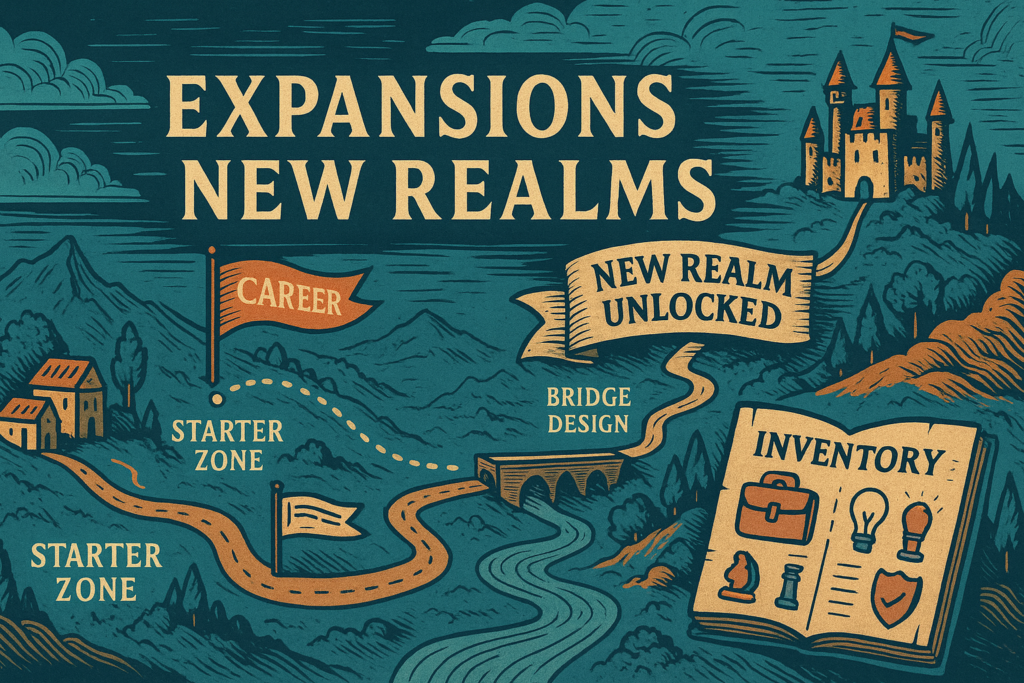
Games release expansions. Careers do too.
You don’t stay in the same starter zone forever.
At some point, the map edges blur, the familiar quests lose their charge, and a quiet signal appears in the corner of your screen:
New realm unlocked.
That moment is easy to mislabel. It can feel like boredom, frustration, or burnout.
But most of the time, it isn’t decay. It’s transition. It’s the early signal that your current role has finished teaching what it was meant to teach.
That moment is not burnout. It’s evolution asking for architecture.
Most people see a career pivot as starting over.
Builders see it as adding a new expansion to an existing world.
The character doesn’t die when the map changes.
The inventory carries forward.
The Real Mechanic Underneath the Metaphor
An expansion doesn’t erase what came before.
It compounds it. New skills attach to old skills. New NPCs arrive, but the player is still you. Only more capable, more aware, more strategic.
The world doesn’t restart when the story shifts.
It widens.
That’s the part career advice often misses. When people talk about “reinvention,” they make it sound like a canyon jump. A dramatic break. A wipe-the-slate moment. But that’s not how mastery is built.
A pivot is not a reset. It is a reallocation of experience points into a different skill tree.
Your past roles become assets, not artifacts.
Every industry shift is another chance to repurpose what you already forged.
That’s the real difference between a career change and a career expansion: one abandons what came before. The other absorbs it.
From IT to Cybersecurity
My own first expansion looked like this.
I spent years building a foundation in IT: troubleshooting systems, managing networks, learning how organizations actually function under pressure. At the time, it felt like technical support: tickets, outages, updates, escalations.
In hindsight, I see it differently.
It wasn’t support.
It was reconnaissance.
I was learning the terrain: how systems break, how people respond, where processes are fragile, and how technology behaves under stress. IT wasn’t the end state. It was the tutorial level for the domain I hadn’t entered yet.
The pivot into cybersecurity wasn’t a heroic leap. It was a realization.
I didn’t need a new identity. I needed a new frame.
The moment it clicked wasn’t dramatic. There was no crisis. There was no “I can’t do this anymore.” What I felt instead was a shift in the type of problems that interested me.
I wasn’t drawn to fixing what was broken. I was drawn to understanding what could be exploited.
The work that once felt like solving outages now felt like studying patterns.
The curiosity that once helped me debug a server became the mindset that helped me threat model an attack surface.
Nothing from the previous map was wasted.
The same skills that once restored uptime became the skills that now prevented breaches.
The expansion didn’t replace the core class. It evolved it.
That’s when I understood: most people are already preparing for their next realm without realizing it. The signals are in the skills they’re tired of, the problems they’re drawn to, and the questions they can’t stop asking.
A pivot always starts quietly; not with a job posting, but with a shift in attention.
The Expansion Cycle (A Builder’s Model)
An expansion is not a leap. It is a design emerging from signal.
Every expansion has a shape.
It’s not chaos. It’s not luck. It follows a pattern.
Once you notice the pattern, the uncertainty around pivoting shrinks. You stop treating career change as a gamble and start treating it like a design process.
The same way a game expansion has stages, a career expansion has phases you can move through with intention instead of panic.
- Signal — The old loop stops creating momentum.
- Inventory: You audit skills, networks, leverage, earned insight.
- Bridge Design: You define the transferable systems, not the tasks.
- New Realm Entry: You ship the first artifact: article, prototype, offer, conversation.
- Integration: The old world feeds the new one; nothing is wasted.
Most people wait for permission.
Builders move when the signal appears; not when the map is fully drawn.
The cycle is not fast, and it’s not dramatic. It’s iterative. You don’t need the final role, the full strategy, or the perfect timing. You just need forward movement and a way to translate what you already know into a new context.
The most dangerous place in a career isn’t the wrong job. It’s the right job held long after its learning curve has flattened.
The Philosophical Shift
You stop asking, “What job title comes next?”
You start asking, “What world do I want to be useful in next?”
That shift turns a résumé into a roadmap.
It turns a career into a campaign.
That’s the moment a career stops being linear and becomes modular.
That’s the moment you step from employee of a system to architect of a system.
When you see your work as a world you’re building, not a ladder you’re climbing, the options multiply.
Jobs become vehicles, not identities.
Skills become tools, not trophies.
Reinvention becomes normal, not risky.
And once you learn to carry forward what you’ve built, expansions stop feeling like leaps. They start feeling like the logical next step.
Start Here
Every expansion begins small. Not with a resignation letter, a certification, or a perfect five-year plan. But with a single decision to test the next version of yourself in the real world.
The goal isn’t prediction. It’s movement toward the first signal that the next realm is reachable.
- List the skills you’ve mastered that are portable, not positional.
- Identify the problems or industries where those skills now have compounded value.
- Define the minimum viable expansion: a conversation, a pilot project, a public experiment, a small paid offer.
Momentum is not found in certainty. It’s found in motion.
Stepping Into the Next Realm
Every career has chapters, but not all of them are written by choice. Some people stay in the first map because it’s familiar. Others leave only when the system collapses around them.
But builders learn a different rhythm: they expand before the world forces them to. They move when the signal arrives, not when the ground disappears.
Every player eventually outgrows the first map.
The only question is whether you wait for someone to hand you the next quest or design the expansion yourself.
The next realm isn’t assigned. It’s chosen.
What expansion are you exploring in your career?
#CareerPath #AI #Innovation #FutureOfWork
This piece first appeared on LinkedIn, where I shared the full article and reflections with my network. You can read the LinkedIn edition on my profile.