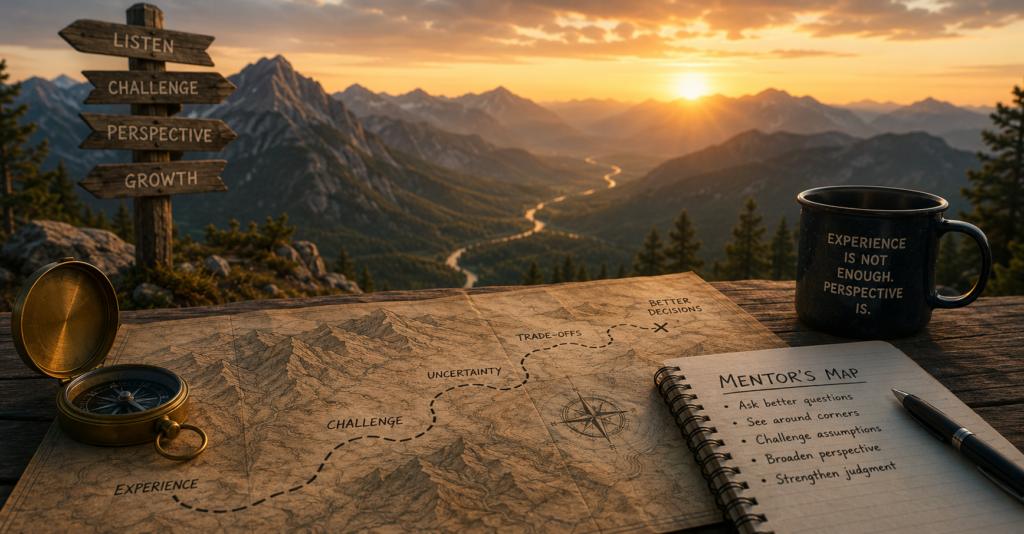
Even experts need a map.
I learned that later than I should have.
Early in my career, mentorship felt obvious. I was learning quickly, asking questions freely, and absorbing everything I could from the people around me. There was no tension in admitting what I did not know because my role was built around growth. The expectation was that I would need guidance.
As responsibility increased, that dynamic changed quietly.
I became the person others came to for answers. The one expected to have perspective, direction, and confidence under pressure. Somewhere in that transition, I stopped seeking mentorship myself. Not intentionally. Not because I thought I had everything figured out. It just became less visible where mentorship fit once you were no longer the junior person in the room.
The mistake was assuming experience alone was enough.
What I eventually realized is that the moments where mentorship mattered most rarely looked like skill gaps. They looked like judgment calls. Decisions where every option carried consequences. Tradeoffs between speed and resilience. Between technical correctness and organizational reality. Between what could be done and what should be done.
At senior levels, the problems change shape.
The higher you go, the fewer situations have clean answers.
That changes what mentorship is for.
Early mentorship is often instructional. You learn tools, frameworks, processes, and technical skills. You borrow experience because you have not yet accumulated enough of your own. But over time, mentorship becomes less about instruction and more about orientation. What I needed was not instruction. I needed orientation.
One mentor in particular changed how I understood that distinction. He rarely told me what decision to make. Instead, he asked better questions than I was asking myself.
What fails if this goes wrong?
Who carries the cost?
What problem are you actually solving?
What assumptions are you making without realizing it?
At the time, those conversations felt slower than I wanted them to feel. I was focused on solving the immediate problem. He was focused on helping me understand the terrain surrounding it.
That difference mattered more than I understood at the time.
Looking back, I can see that he was not giving me answers. He was calibrating how I thought. Helping me recognize variables I was overlooking. Helping me see that most difficult decisions are not technical puzzles waiting for the correct solution. They are systems problems shaped by constraints, incentives, timing, and incomplete information.
Experience changes your responsibilities. It does not eliminate blind spots.
If anything, experience can make some blind spots harder to recognize. The more capable you become, the easier it is to rely on your existing mental models. You solve problems faster. You make decisions with less hesitation. People trust your judgment more readily. That confidence is useful, but it also creates risk. Expertise narrows uncertainty in some areas while creating overconfidence in others.
That is one of the least discussed challenges of senior leadership. As people become more experienced, they often receive less honest calibration. Fewer people challenge assumptions directly. Fewer people ask uncomfortable questions. The feedback loop weakens at the exact moment the consequences of decisions become larger.
Most leaders do not need constant instruction.
They need perspective.
They need people who can help them recognize where their own thinking has become too narrow, too reactive, or too anchored to past experience. They need people who can slow down a decision long enough to examine what sits underneath it.
Good mentorship creates friction in the right places.
Not obstruction. Not ego. Not performative disagreement.
Useful friction.
The kind that forces you to reconsider an assumption before it hardens into architecture.
That is why I think mentorship becomes more important, not less, as responsibility increases. The stakes grow. The systems become more complex. The tradeoffs become less visible and more consequential. And eventually, many of the people around you stop telling you what they really think unless you create space for it intentionally.
The isolation that comes with expertise is subtle. Most people do not notice it happening in real time.
You become known for competence, and competence changes how people interact with you. Questions become shorter. Challenges become softer. Conversations become more transactional. Over time, it becomes easier to operate inside your own perspective without realizing how much your environment has adapted around it.
That is part of why mentorship at senior levels matters so much. It interrupts perspective drift.
A good mentor does not just help you make better decisions. They help you recognize how you are making decisions in the first place.
That distinction matters.
Mentors and advisors are not the same. Advisors solve immediate problems: they provide expertise, recommendations, or tactical guidance. Mentors operate differently. They shape how you interpret situations over time. The impact is slower, but deeper.
Some of the most valuable people in my career have simply been individuals who consistently asked thoughtful questions, challenged easy assumptions, or introduced perspective at the right moment. They were not trying to mentor me formally. They were helping me see more clearly.
That is usually what growth feels like at senior levels: small recalibrations that compound over time. A different framing of risk. A better understanding of incentives. A more accurate read on organizational pressure. A clearer view of what happens downstream from a decision. The changes are subtle when they happen. Their impact is not.
That has changed how I look for mentors now. Earlier in my career, I looked for people who had answers I did not have. Now I look for people who can help me see around corners. People who understand systems deeply enough to recognize second-order effects before they become visible to everyone else.
Not people who eliminate uncertainty.
People who help navigate it.
There is an important difference between confidence and clarity. Some people project certainty because they think leadership requires it. The mentors who shaped me most rarely projected certainty at all. What they offered instead was perspective. The ability to slow a problem down enough to examine the structure underneath it.
I think many senior leaders misunderstand what mentorship requires. They assume they need to be the smartest person in the room or hold the perfect answer. In reality, some of the most valuable mentorship moments come from helping someone ask a better question than they were asking before.
Leadership is not always about providing direction.
Sometimes it is about helping someone recognize the terrain they are already standing on.
That shift matters because many professional decisions are not solved through knowledge alone. They are solved through interpretation. Through understanding incentives, timing, organizational dynamics, and consequences that are not immediately obvious. Technical skill matters. Experience matters. But perspective determines how those things get applied.
That is why even experts still need maps.
Not because they are lost.
Because the terrain changes as responsibility increases.
And because no one sees the full landscape alone.
Who has been a mentor on your journey, and what perspective did they help you see differently?
This piece first appeared on LinkedIn, where I shared it as a reflection and opened the conversation with my professional network.